Testing, Tracking, and Toeing the Line: A Role Play on the Origins of the Modern High School
Teaching Activity PDF. By Bill Bigelow. 13 pages.
A role play on the origins of the modern high school.
Download PDF.
What we don’t teach in school can be more important than what we do teach. When we fail to engage students in thinking critically about their own schooling, the hidden message is: Don’t analyze the institutions that shape your lives; don’t ask who benefits, who suffers, and how it got to be this way; just shut up and do as you’re told.
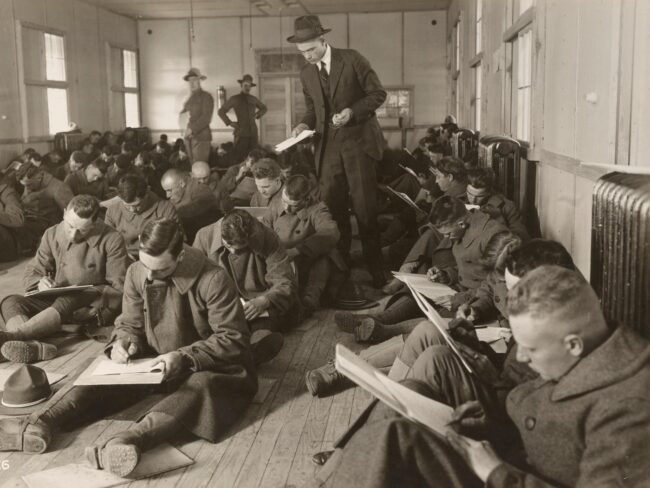
To explore some of the historical roots of the modern high school, I wrote a role play that I hoped would allow students to question aspects of schooling they often take for granted, such as tracking (“ability grouping”), standardized testing, guidance counseling, student government, the flag salute, bells, required courses with patriotic themes, and extracurricular activities like athletics and the school newspaper. These now commonplace components of high school life were introduced in the early years of the 20th century, a time of growing union militancy and radicalism, and large-scale immigration from southern and eastern Europe, accompanied by vastly increased high school enrollment.
Underlying the new reforms was a consensus among leading educators that social class stratification was here to stay, and that high schools should abandon a single academic curriculum for all students.
Published by Rethinking Schools.
Key words: George Strayer, Stanford, IWW, IQ, patriotism, school reform, education.
Background Materials
Paul Davis Chapman, Schools as Sorters, New York University Press, 1988 (especially Chapter 5, “The Use of Intelligence Tests in Schools: California Case Studies”).
David Tyack, The One Best System: A History of American Urban Education, Harvard University Press, 1974.
Joel Spring, The American School, 1642-1985, Longman, 1986 (especially Chapter 7, “Education and Human Capital”).
Robert S. Lynd and Helen M. Lynd, Middletown, Harcourt, Brace, 1929 (especially part II: “Training the Young”).
Jeannie Oakes, Keeping Track: How Schools Structure Inequality, Yale University Press, 2005 (Chapter 2, “Unlocking the Tradition”).
Samuel Bowles and Herbert Gintis, Schooling in Capitalist America, Basic Books, 1976, (Chapters 5 and 6, “The Origins of Mass Public Education” and “Corporate Capital and Progressive Education”).
Post a comment
Explore by Time Period
- Colonization
- Revolution & Constitution
- Early 19th Century
- Civil War Era
- Reconstruction Period
- Industrial Revolution
- Turn of the Century
- World War I
- Prosperity, Depression, & World War II
- Cold War
- People’s Movement
- 1975 – 2000
- 2001 – Present
- 18th Century
- 19th Century
- 20th Century
- All US History
- 21st Century
Explore by Theme
- African American
- Art & Music
- Asian American
- Civil Rights Movements
- Criminal Justice
- Democracy & Citizenship
- Disability
- Economics
- Education
- Environment & Food
- Immigration
- Imperialism
- Individuals in US History
- Labor
- Language Arts
- Latino
- Laws & Citizen Rights
- LGBT
- Media
- Native American
- Organizing
- Pacific Islander
- Racism & Racial Identity
- Science
- Slavery
- Social Class
- Sports
- US Foreign Policy
- Wars & Related Anti-War Movements
- Women's History
- World History/Global Studies
List of Resources
- Articles
- Audio
- Books: Fiction
- Books: Non-Fiction
- Films
- Picture Books
- Posters
- Profiles
- Songs and Poems
- Spanish/Bilingual
- Teaching Activity PDFs
- Teaching Guides
- Websites
Reading Level
Facebook Status
Zinn Education Project
Saturday, February 4th at 7:12 Today is the birthday of Rosa Louise McCauley Parks (Feb. 4, 1913 – Oct. 24, 2005). Below is a key article by Herbert Kohl from Rethinking Schools that challenges the myths prevalent in children's books and textbooks about Rosa Parks. Here is a link to more resources about Parks and the Montgomery Bus Boycott: http://zinnedproject.org/posts/tag/rosaparks
The Politics of Children’s Literature: What’s Wrong with the Rosa Parks Myth
zinnedproject.org
Aritcle. By Herbert Kohl. 6 pages. A critical analysis that challenges the myths in children’s books about Rosa Parks and the Montgomery Bus Boycott.
Zinn Education Project
Saturday, February 4th at 0:40 via ColorLines Magazine People have taken to Twitter to talk about the histories they wish they'd learned about in high school. Use: #WishiLearnedinHS
Pay Attention! Ethnic Studies #WishiLearnedinHS Curriculum Hits Twitter - COLORLINES
colorlines.com
Educational policies start trending on Twitter.
Zinn Education Project
Friday, February 3rd at 7:25 On this day in 1944, U.S. forces invaded and took control of the Marshall Islands. Who was living there? What is the status of the islands today? The Insular Empire: America in the Marianas is a powerful film on the U.S. colonies in the western Pacific.
Suggestion: ask your students - "Does the U.S. have colonies?" Let us know how they respond.
The Insular Empire: America in the Mariana Islands
zinnedproject.org
The Insular Empire is a one-hour PBS documentary about America’s colonies in the western Pacific. Six thousand miles west of California, the Mariana Islands include the U.S. Territory of Guam and the U.S. Commonwealth of the Northern Mariana Islands (or CNMI). Although most Americans don’t believe t...
You must login to comment.