

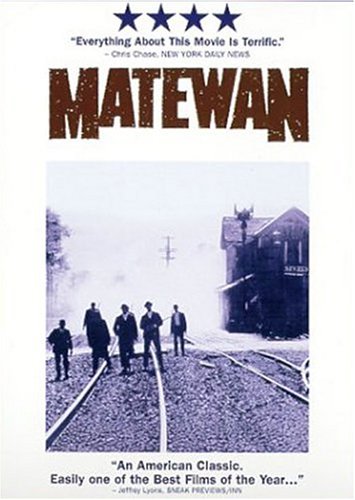
 John Sayles’ feature film Matewan is about a strike in a mining town in Appalachia. Mine owners bring in black workers in an attempt to break the strike. Can Italian immigrants, white Appalachians, and African Americans work together? Should they even bother to try? A powerful and well-crafted film based on a true story.
Eric Foner describes the film as follows in Past Imperfect: History According to the Movies, edited by Mark Carnes:
Matewan tells the story of a bitter 1920 strike in the coal mines of southern West Virginia. The struggle culminates in the Matewan Massacre, a violent (and historically accurate) confrontation in which the town’s mayor, seven armed guards hired by the coal operators, and two miners lost their lives. However, this film does more than chronicle a particularly dramatic episode in American labor history.
In the hands of director John Sayles, Matewan offers a meditation on broad philosophical questions rarely confronted in American films: the possibility of interracial cooperation, the merits of violence and nonviolence in combating injustice, and the threat posed by concentrated economic power to American notions of political democracy and social justice.
Although Matewan is peopled with actual historical figures — notably Sid Hatfield, the town’s pro-union chief of police and the central protagonist in the massacre — Sayles uses two fictional characters to propel the plot. One is Danny Radnor — a boy preacher, miner, and union supporter — in whose voice as narrator, looking back from fifty years later, the story of Matewan is told. The second is the film’s main character, Joe Kenehan, a World War I veteran, former member of the Industrial Workers of the World, organizer for the United Mine Workers of America, and committed pacifist. . .
. . . Through music, regional accents, and numerous local characters, Sayles successfully creates a sense of the Matewan community. Visually, too, the film is remarkably effective, thanks to Haskell Wexler’s careful and deliberate cinematography. Dramatic as it is, Matewan is not ‘entertaining’ in the conventional sense. With its accented dialogue often difficult to follow and its slow-moving pace, it demands concentration on the part of the viewer, but partly because of this, it succeeds admirably in creating a sense of time and place.
Distributed by Cinecom Pictures.
Trailer
Related Resource
Thinking in Pictures: The Making of the Movie Matewan by John Sayles. The short essay “Why Matewan?” in this book is useful to share in class when showing this film.


The movie “Matewan” is, as you say, a powerful movie… on many levels. Unfortunately, the movie is a total fictional account of the incident. Virtually nothing in the film actually happened in Matewan up to and including the events of May 19, 1920. The power of the movie is that it is a catalyst for misinformation and outright lies as to the persons and events portrayed – hence it has spread these falsehoods throughout the media and internet and people have latched onto them as if they were facts. John Sayles, who wrote and directed the movie, stated that it is a work of fiction, but that has not stopped the falsehood that it is referenced as fact. The truth of the matter is that the Matewan chief of police, Sid Hatfield, along with miners and union officials, orchestrated the mass murder of eight people including the mayor of Matewan, C.C. Testerman (Sid was having an affair with the mayor’s wife.)
The “reenactment” itself dutifully recreates the misinformation from Sayle’s film. There was no “shoot out” as portrayed in the film. The detectives were for the most part, unarmed and were slaughtered in their tracks. Only three had permits to carry guns and the rest were unarmed, having stowed their weapons in locked satchels before leaving the Urias Hotel to go meet the incoming No. 16 train. The superintendent of the detectives, Albert Felts, was a deputy sheriff of Mingo County and the first person killed in the foray. (Sheriff Blankenship had appointed him two years prior {page 487 – Congressional Hearings 1921}).
Your statement that “This film is based on solid historical events in West Virginia coal mining country” is not accurate and is misleading by insinuating the film is truthful. This film was released in 1987, three years before the papers of T.L. Felts were discovered and donated to the Eastern Regional Coal Archives in Bluefield. These papers included comprehensive newspaper files of the Massacre and subsequent trial. It also included the interoffice memos of the Baldwin-Felts Detective Agency as it went about investigating the incident – which is a wealth of information that was never meant to be made public. T.L. Felts, a partner in the detective agency, had destroyed all the files of the agency when they disbanded it in 1937, but having lost two brothers in the incident, I can understand how he was hesitant to destroy these papers. The files also included the actual court documents of the Massacre trial held in Williamson.
I have read all of these papers, also the Congressional Hearings in 1921 and every facet of information that I could gather as to this incident. My conclusion is that the movie Matewan has not a shred of truth in it. As for the trial and acquittal of Sid and eighteen others, the judge presiding over the case, JD Baily, stated in 1961 to Howard B. Lee, the author of Bloodletting in Appalachia, that the defense testimony in the Matewan trial “was a tissue of the most fantastic falsehoods he ever had to listen to during his years on the bench.”
The truth will set you free…
This artifact is an excellent piece of historical evidence that ought to be taught in public schools. There is a plethora of knowledge denied to our students.