

Evocative primary source documents are especially important to our discussions of World War I. While any analysis of the war “to make the world safe for democracy” demonstrates the downward spiral into militaristic violence that ushered in a century of unparalleled destruction, most traditional discussions are devoid of antiwar voices and actions. Yet without this perspective, students leave the subject of World War I thinking that the vast majority of Americans willingly fought in the war and/or unquestioningly supported the war effort. As historians, we know that such was not the case.
In Chapter 14 of Voices of a People’s History of the United States, students are exposed to first-hand accounts of how Americans opposed the war and the trend toward militarism. These voices not only illustrate the widespread nature of the antiwar movement, they also highlight the federal government’s calculated reaction to the movement and the way in which the war influenced art and literature among the generation who survived the war.

From Library of Congress.
Our students will learn of the dynamic nature that comprised the antiwar appeal to the imperialistic foundation of the war, and they will come away with an understanding of how the views of these antiwar activists were, in many cases, systematically suppressed. Finally, these documents of resistance better equip our students with the tools they will need to become, critical, responsive and thorough practitioners of historical thought.
Reprinted from Teaching with Voices of a People’s History of the United States, published by Seven Stories Press.
Text Excerpts and Readings
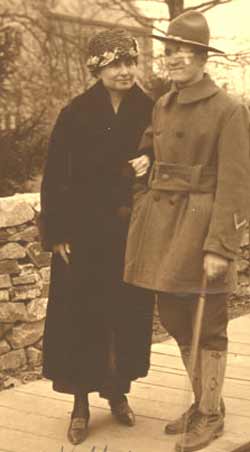
Helen Keller with a soldier.
Excerpts from the January 5, 1916 speech by Helen Keller at Carnegie Hall, from Chapter 14 of Voices of a People’s History:
“The future of the world rests in the hands of America. The future of America rests on the backs of 80,000,000 working men and women and their children. We are facing a grave crisis in our national life. The few who profit from the labor of the masses want to organize the workers into an army which will protect the interests of the capitalists . . .
“Congress is not preparing to defend the people of the United States. It is planning to protect the capital of American speculators and investors in Mexico, South America, China, and the Philippine Islands. Incidentally, this preparation will benefit the manufacturers of munitions and war machines . . .
“Every modern war has had its root in exploitation. The Civil War was fought to decide whether slaveholders of the South or the capitalists of the North should exploit the West. The Spanish-American War decided that the United States should exploit Cuba and the Philippines. The South African War decided that the British should exploit the diamond mines. The Russo-Japanese War decided that Japan should exploit Korea . . .
“Strike against all ordinances and laws and institutions that continue the slaughter of peace and the butcheries of war. Strike against war, for without you no battles can be fought. Strike against manufacturing shrapnel and gas bombs and all other tools of murder. Strike against preparedness that means death and misery to millions of human beings. Be not dumb, obedient slaves in an army of destruction. Be heroes in an army of construction.”
Read full speech online.
The Truth About Helen Keller
The Truth About Helen Keller is a critical analysis of the representation of Helen Keller in children’s literature and textbooks.
10 Readings for Students
Chapter 14 of Voices of a People’s History, “Protesting the First World War” offers 10 readings for students with perspectives that are often missing from textbooks.
- Helen Keller, “Strike Against War” (January 5, 1916)
- John Reed, “Whose War?” (April 1917)
- “Why the IWW Is Not Patriotic to the United States” (1918)
- Emma Goldman, Address to the Jury in U.S. v. Emma Goldman and
- Alexander Berkman (July 9, 1917)
- Two Antiwar Speeches by Eugene Debs (1918)
- “The Canton, Ohio Speech” (June 16, 1918)
- Statement to the Court (September 18, 1918)
- Randolph Bourne, “The State” (1918)
- e.e. cummings, “i sing of Olaf glad and big” (1931)
- John Dos Passos, “The Body of an American” (1932)
- Dalton Trumbo, Johnny Got His Gun (1939)


Twitter
Google plus
LinkedIn