

Shortly after the September 11 attacks on the World Trade Center and the Pentagon, President George W. Bush announced these as acts of war, and proclaimed a “war on terrorism.” But what exactly was to be the target of this war? And what precisely did the president mean by terrorism? Despite uttering the words “terror,” “terrorist,” or “terrorism” 32 times in his September 20 speech to the nation, he never defined terrorism.
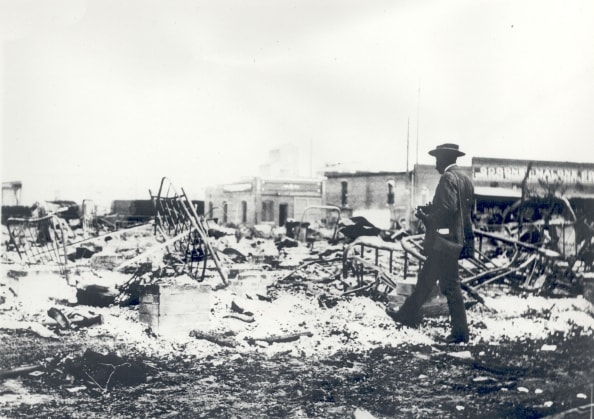
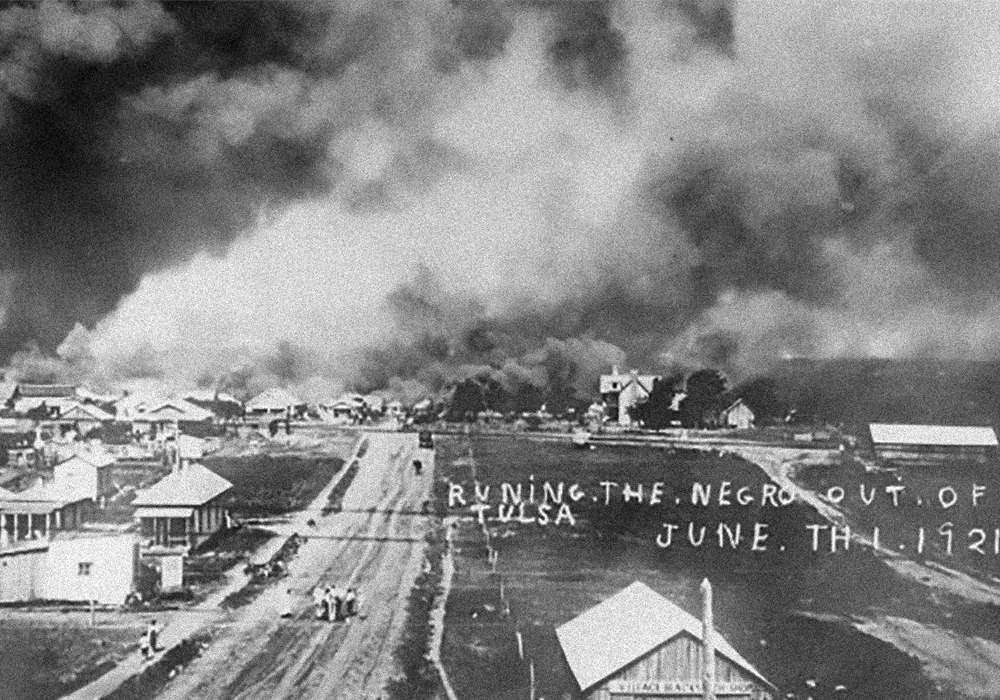
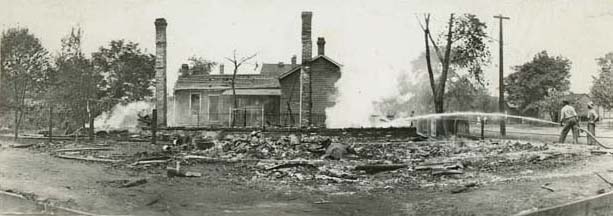
Homes and businesses of African Americans destroyed by white supremacists during the Tulsa Massacre of 1921. Why don’t textbooks call this terrorism?
Teachers need to engage our students in a deep critical reading of terms — such as “terrorism,” “freedom,” “patriotism,” and “our way of life” — that evoke vivid images but can be used for ambiguous ends.
I wanted to design a lesson that would get students to surface the definitions of terrorism that they carry around — albeit most likely unconsciously. And I wanted them to apply their definitions to a number of episodes, historical and contemporary, which involved some kind of violence or destruction. I didn’t know for certain, but my hunch was that as students applied definitions consistently, they might be able to call into question the “We’re Good/They’re Bad” dichotomies that have become even more pronounced on the political landscape.
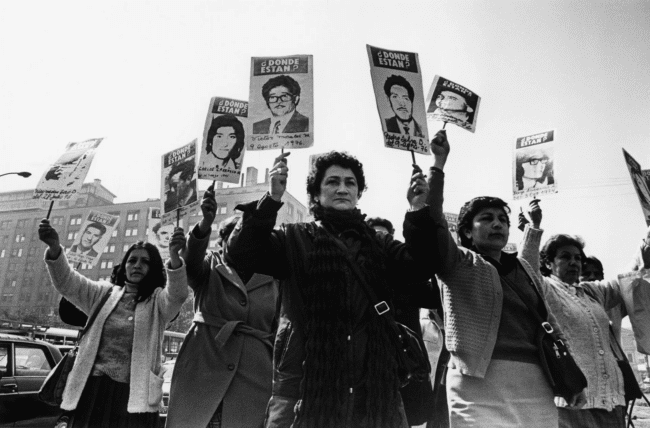
Protestors demand an end to the dictatorship of Augusto Pinochet and the forced disappearances, torture, executions, and biological weapons that accompanied his reign. Source: Public domain
So I wrote up several “What Is Terrorism?” scenarios, but instead of using the actual names of countries involved, I substituted fictional names. Given the widespread conflation of patriotism with support for U.S. government policies, I had no confidence that students would be able to label an action taken by their government as “terrorism” unless I attached pseudonyms to each country.
. . .
Students read the scenarios and based on the definitions of terrorism that their group came up with, decide:
1. Which of the situations below are “terrorism”;
2. Who are the “terrorists” in the situation; and
3. What additional information you would need to know to be more sure of your answers.
Classroom Stories
I use the Zinn Education Project in my classroom quite often. My favorite lesson is entitled Whose “Terrorism”?, which gives students perspective on what terrorism is and how it works. The lesson lets the educator teach from the perspective of the other, which is crucial to the classroom of today. A great resource which I plan on using more.
I teach Whose “Terrorism”? every year. I used to work in a small, rural, impoverished school and now I work in a larger, urban, but equally impoverished and traumatized school. I find connections between the two environments daily and always marvel in their similarities despite the differences in the school communities. However, one of the biggest differences is that now we are in daily fear of when ICE will arrive for some of our students. We keep revisiting our response plan.
When I first started teaching this lesson, I was worried that the kids either wouldn’t get it, or it would be too much text for them to read. I split the stories up among groups, gave each group one story, and took it step by step. I was astonished and heartened when the students — all of them, 7th and 8th grades, in both schools — pretty quickly understood what was going on in their examples. The students were horrified by many of the examples.
We always take this opportunity to discuss that this is not meant to vilify the United States, but to make sure that we are looking at all of these examples in order to discover the truth. And that the United States can do better. These students are the future leaders of our country, and their role is to help the country live up to its promise, and to do better now that we know better. By framing it in this way, it does not come off as a negative story, down on the United States, but rather a way for them to understand the world, and also for them to understand that we can strive to make this country a better place.
I am fortunate enough to be in contact with many of my former students, and they remember this lesson. To me, that is the ultimate seal of approval.
I’ve used a number of Zinn Education Project lessons in my classroom and one that I’ve found both very useful and highly adaptable for different classrooms is Whose “Terrorism”? The act of reframing real-world events with fictional countries and individuals allows students to authentically debate what qualifies as terrorism, what doesn’t, and what responses may or may not be appropriate, without bringing real-world stereotypes and preconceptions into play.
So many of my students automatically assume everything the U.S. does is good (or, occasionally, bad) without looking at both sides of the story. There’s often a great “Aha!” moment when I compare the fictionalized stories to the real-world events that inspire them and they see their stereotypes shattered.
Because I teach in a small-classroom, special ed context, I often have to adapt pre-made lessons I find online for my students’ needs and reading levels. This particular lesson was easy to differentiate for my students. Not only is this a great lesson, but I’ve used the basic concept of it in other lessons since, creating fictional countries in place of real world ones to help students look at events more objectively.

I have used the Whose “Terrorism”? lesson with students for several years now and my students love it!
If your students are like some that I’ve had, they believe that terrorism is exclusive to Middle Eastern-based groups or religious zealots. So this activity is a true eye-opener. It allows us to have authentic conversations about what they think terrorism is and what terrorism is not. By removing the names that may inadvertently cause their opinions to be biased, students are able to look critically at actions involving our own country in an objective way.
We are able to investigate the gray areas that might be considered terrorism by some and war tactics by others. My students are always amazed at how many of these situations actually involved the United States as the perpetrator of things that they deem to be terrorism. This lesson also gives us a chance to reinforce the idea of looking at historical events with various perspectives.
The next time that I use this lesson, I think that I am going to extend it a bit more to ask groups of students to do a little research on the real-life situation’s aftermath to share with us what happened next, did others outside of the situation deem it to be an act of terror, and what were the repercussions.

I broke the students up into groups of two and assigned each group to look at one of the ten scenarios in the lesson Whose “Terrorism”? and decide if it was terrorism, and, if so, who was the terrorist. This was after a brief intro to terrorism, to which their main point of reference was 9/11.
I read the 10th scenario aloud and asked the students to identify the company. Several did guess Nike, and while they did not think it was terrorism, after a lengthy discussion on the idea of minimum wage vs. living wage, they concluded it was pretty despicable behavior.
While my teaching style tends to touch upon many subjects, the Zinn Education Project resources often lean into this style allowing for really interesting discussions that move well beyond the recitation of facts and ideas, and touch upon ideas that will continue to be relevant for students long after class is over.
For homework, I made a worksheet with all the correct country and person names, and tasked students with identifying each. The following class, we had a discussion about each event, who was the terrorist, who was in the wrong, and their thoughts. With my AP U.S. history students, who have a bit more awareness, we also touch upon January 6th and how it relates to terrorism.

This lesson was published by Rethinking Schools in a Rethinking Schools Special Report, “War, Terrorism, and Our Classrooms: Teaching in the Aftermath of the September 11th Tragedy.” For more articles and lessons like “Whose ‘Terrorism’?,” visit Rethinking Schools.


Thank you. I plan to use this in my class tomorrow!
I like your activity. I have created a similar one based more on action of the American Revolution. It is interesting when students discuss events like the Boston Tea Party and excerpts from people like Thomas Jefferson and attempt to determine if the actions are terrorism or the people are terrorists. It is even more interesting when they change their minds once they know the event or person we are discussing.
This may help illustrate this lesson for your students. http://www.theatlantic.com/politics/archive/2012/05/is-one-mans-terrorist-another-mans-freedom-fighter/257245/