The Election of 1860 Role Play
Teaching Activity PDF. By Bill Bigelow. 12 pages.
Role play based on the election of 1860 allows students to explore the political debates of the time and the real reasons for the Civil War.
Download PDF.
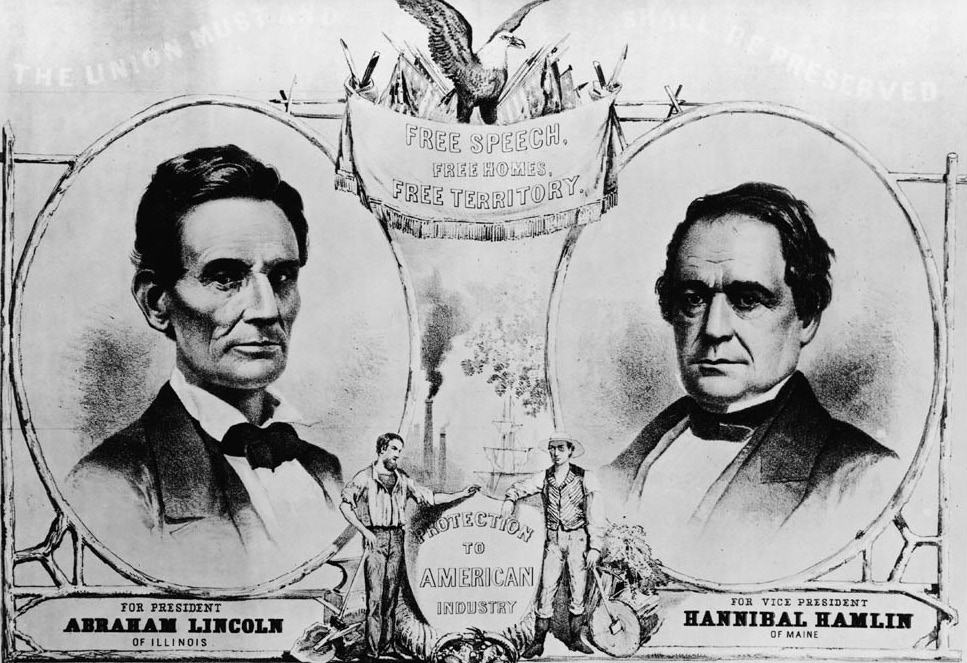
Most of my students share a cartoonlike version of the causes of the Civil War: slavery was horrible; President Abraham Lincoln was a great man who hated slavery; so, to free the slaves, he fought a war against the South; the North won and the slaves were freed. This common but wildly inaccurate history reinforces at least two unfortunate myths: the United States fights wars only for high moral purposes; and African Americans owe their freedom to the efforts of a great white man. The activities in this lesson offer students a more complex and truthful historical picture, and, thus, help to puncture these myths.
Four political parties competed for the presidency in 1860. The outcome resulted in a social earthquake that permanently transformed the United States of America. The role play asks students to confront the actual issues addressed by the different parties in 1860. It gives students the tools to analyze some of the main causes of the Civil War, and helps them expel the simplistic notions of the war’s aims that they may, perhaps unconsciously, carry around.
Published by Rethinking Schools.
Key words: Civil War, Abraham Lincoln, Stephen Douglas, slavery, African American, north, south.
Post a comment
Explore by Time Period
- Colonization
- Revolution & Constitution
- Early 19th Century
- Civil War Era
- Reconstruction Period
- Industrial Revolution
- Turn of the Century
- World War I
- Prosperity, Depression, & World War II
- Cold War
- People’s Movement
- 1975 – 2000
- 2001 – Present
- 18th Century
- 19th Century
- 20th Century
- All US History
- 21st Century
Explore by Theme
- African American
- Art & Music
- Asian American
- Civil Rights Movements
- Criminal Justice
- Democracy & Citizenship
- Disability
- Economics
- Education
- Environment & Food
- Immigration
- Imperialism
- Individuals in US History
- Labor
- Language Arts
- Latino
- Laws & Citizen Rights
- LGBT
- Media
- Native American
- Organizing
- Pacific Islander
- Racism & Racial Identity
- Science
- Slavery
- Social Class
- Sports
- US Foreign Policy
- Wars & Related Anti-War Movements
- Women's History
- World History/Global Studies
List of Resources
- Articles
- Audio
- Books: Fiction
- Books: Non-Fiction
- Films
- Picture Books
- Posters
- Profiles
- Songs and Poems
- Spanish/Bilingual
- Teaching Activity PDFs
- Teaching Guides
- Websites
Reading Level
Facebook Status
Zinn Education Project
Thursday, February 9th at 13:07 The National Museum of the American Indian is in the early planning stages for an exhibit on the Native people of New York State and the surrounding regions. They seek insights into how teachers are covering historic and contemporary issues around Native Americans in their classrooms so that they can best integrate the needs of students and teachers into the exhibition. If you are currently teaching, or have recently taught content related to Native Americans from the Northeast, they would appreciate hearing your input on the survey at the link below. As a thank you, you will automatically be entered in a raffle to win one of three books.
Zinn Education Project
Thursday, February 9th at 7:31 On this day in 1950, Wisconsin Senator Joseph McCarthy delivered a speech during which he claimed to hold a list of known communists in the U.S. State Dep't. The speech grabbed national headlines and launched the paranoia and persecution now known as “McCarthyism.”
Here are classroom resources, including a young adult novel, on McCarthyism:http://zinnedproject.org/posts/tag/mccarthyism
Are there other books, films, lessons you recommend to teach about McCarthyism?
History in Pictures - February
On Feb 9, 1950, Wisconsin Senator Joseph McCarthy delivered a speech at the McLure Hotel during which he claimed to hold a list of known communists in the U.S. State Department. The speech grabbed national headlines and launched the paranoia and persecution now known as “McCarthyism.”
Here are classroom resources, including a young adult novel, on McCarthyism: http://zinnedproject.org/posts/tag/mccarthyism
History in Pictures features just a few of the many stories that are often left out of the textbooks. The sources for these stories include: This Week in History from Peace Buttons (http://www.peacebuttons.info/E-News/thisweek.htm), Planning to Change the World: A Social Justice Plan Book for Teachers (http://www.justiceplanbook.com/), This Day in Civil Rights History (http://zinnedproject.org/posts/13684), History.com (http://www.history.com/this-day-in-history), 50 American Revolutions You Are Not Supposed to Know (http://zinnedproject.org/posts/11632), A People's History of the United States (http://zinnedproject.org/posts/67), Black Facts Online (http://www.blackfacts.com), Today in Labor History (http://www.unionist.com/big-labor/today-in-labor-history), and many more.
Zinn Education Project
Thursday, February 9th at 7:04 Happy birthday Alice Walker. A good day to listen to one of Walker's interviews on Democracy Now!.
Please share your favorite book, essay, or quote by Alice Walker.
Alice Walker on "Overcoming Speechlessness: A Poet Encounters the Horror in Rwanda, Eastern Congo an
www.democracynow.org
As the 2010 Pulitzer Prize winners are announced, we speak with the first African American woman to be awarded a Pulitzer Prize for fiction: author, poet and activist Alice Walker. She was awarded the 1983 Pulitzer for her novel The Color Purple. She was written many books since then. Her latest, ju...

You must login to comment.