

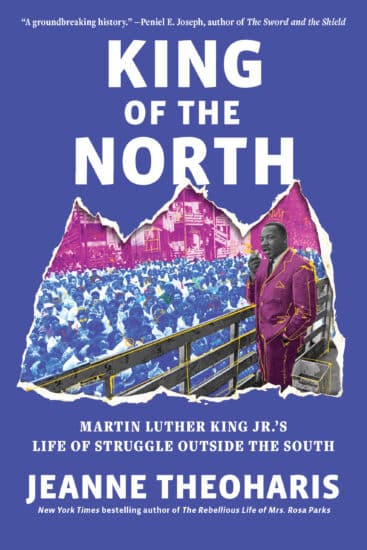
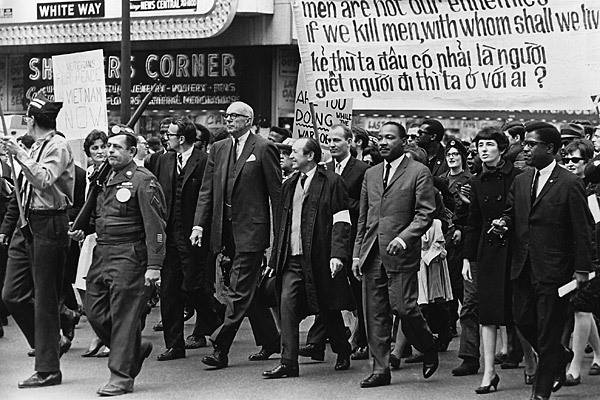
 King of the North fundamentally reshapes how we understand the evolution of Martin Luther King Jr.’s politics and partnerships. While most accounts frame King’s activism as a Southern story culminating in the March on Washington, Theoharis insists we follow him north — into the segregated schools, redlined housing, and brutally policed neighborhoods of Chicago, New York, Los Angeles, Boston, and beyond.
Crucially, the book illuminates King’s sharp critique of liberalism — his frustration with those who claimed to support civil rights while resisting structural change. He saw how Northern officials, journalists, and self-proclaimed allies were often more committed to order than to justice, preferring improvement over equality, and sentiment over transformation.
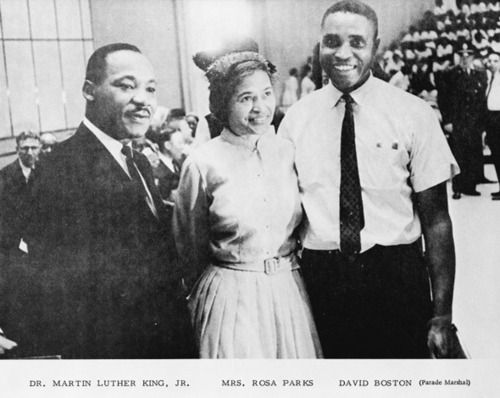
This book not only reclaims King’s fierce critiques of Northern racism, structural economic injustice, and the violence of U.S. militarism — it also spotlights the evolution of his thinking on gender and economic justice, particularly through his engagement with welfare rights activists and the unwavering influence of Coretta Scott King. Too often sidelined, Coretta emerges here not simply as a supportive spouse, but as a visionary in her own right who shaped King’s radical commitments and anti-imperialist politics.
Through meticulous research and narrative clarity, Theoharis restores Dr. King’s relevance for today’s struggles and repositions Coretta Scott King as a central figure in the Black freedom movement. King of the North is essential reading for anyone seeking to understand the full scope of their legacy — and the unfinished business they left behind. [Description from Rethinking Schools.]
ISBN: 9798893851083 | New Press
Endorsements
With insightful precision and narrative power, Theoharis shows that the struggle to end Jim Crow was by every measure a national movement. For the first time in a King biography, Coretta Scott King’s active partnership in the struggle is made clear. King of the North is a revelation. — Barbara Smith, co-founder of the Combahee River Collective
Theoharis delivers another revelatory, meticulously documented account that revises our fundamental assumptions about American history, with critical implications for our future. This indispensable book is a vital resource for all who seek to ‘make real the promise of democracy.’ — Alondra Nelson, Institute for Advanced Study
This stirring reexamination of MLK’s legacy argues that his work has been drastically misremembered and misrepresented by history in order to preserve a simplistic vision of the civil rights movement as concerned only with Southern racism. Instead, King’s critiques of Northern racism were extensive and long-running, as Theoharis extensively documents. It’s a stunning revisionist account of King’s life and politics. — Publishers’ Weekly
Classroom Story
I will be using King of the North for upcoming lessons in my Chicago history class. Students will read excerpts from the following sections:
- “As segregated as Birmingham”
- “Never seen mobs as hostile”
- Negotiations, an Agreement, and the Mayor’s Duplicity
Prior to reading, I will ask students to describe what they have been taught about Martin Luther King. After reading, we will have a group discussion. Reactions will be solicited, and they will be asked to speculate on why this part of King’s work is not taught.
Before this reading, there will be lessons about the Red Summer, redlining, suburbanization, and “urban blight.” This will all be part of an overall unit entitled “Movement, the Mob, and the Machine.” It will culminate with a field trip to the National Public Housing Museum and their summative neighborhood project for the semester, which draws from The Folded Map Project and its subsequent book, Don’t Go, by Tonika Lewis Johnson and Maria Krysan.
King of the North will provide important context on how these events connect, and why they have continued to shape Chicago even today.



Twitter
Google plus
LinkedIn