

Frequently Asked Questions
What is the goal of the Zinn Education Project?
The goal of the Zinn Education Project is to introduce students to a more accurate, complex, and engaging understanding of United States history than is found in traditional textbooks and curricula. The empowering potential of studying U.S. history is often lost in a textbook-driven trivial pursuit of names and dates. People’s history materials and pedagogy emphasize the role of working people, women, people of color, and organized social movements in shaping history. Students learn that history is made not by a few heroic individuals, but instead by people’s choices and actions, thereby also learning that their own choices and actions matter.
We believe that by taking a more engaging and more honest look at the past, we can help equip students with the analytical tools to make sense of — and improve — the world today. For a more complete description, read A People’s History, A People’s Pedagogy.
Who uses the Zinn Education Project?
Teachers and teacher educators in every state and territory in the U.S. download lessons from the Zinn Education Project website.
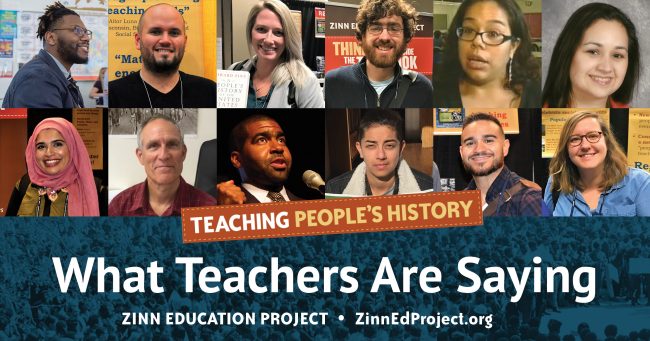
To date, more than 175,000 teachers have signed up to access the free people’s history lessons and thousands more teachers sign up every year. The majority of educators who download the lessons are middle and high school social studies teachers in public, public charter, parochial, private, and home schools. In addition, there are teachers in other subject areas, librarians, administrators, and other school staff.
Every day we receive testimonials from teachers about the power of our lessons, classes, campaigns, and study groups. Read some of the testimonials on this page and many can be found on the pages with respective lessons.
Why is this project named after Howard Zinn?
The Zinn Education Project was inspired by a scene from the documentary You Can’t Be Neutral on a Moving Train, in which Howard Zinn is speaking to high school students in Chicago about American history, and by a donor’s own experience of having Zinn as a professor. The donor wanted to honor Howard Zinn’s extraordinary contributions to the field of promoting “a people’s history,” and in particular his book A People’s History of the United States, which has sold more than four million copies and has been translated into many languages.
While named for Zinn, we seek to highlight the many resources on people’s history — including those published before and after A People’s History of the United States. (See a sample list of people’s historians.)
What do you mean by downloadable “teaching activities”?
A people’s history requires a people’s pedagogy to match. The teaching activities feature strategies that illustrate how a people’s history can be brought to life in the classroom. They are comprised of reflections on teaching about a people’s history, lessons, and critical reviews of literature. All of the suggested lessons have been used in classrooms and revised over time. Most of the lessons were first published by Rethinking Schools.
Many of the lessons are role plays. Before using those lessons, we encourage teachers to read, How to — and How Not to — Teach Role Plays.
How can I support this work?
We can use support in numerous ways. Please see our Support page to find out how.
How do I join your e-mail list?
To receive our e-newsletters, register at the Zinn Education Project website. You will be automatically added to our mailing list. Registration is free.
Why should students study history?
Howard Zinn answers this and other commonly asked questions about teaching a people’s history in this interview. The questions include:
-
- What do you see as some of the major problems in how U.S. history has been taught in this country?
- How do you prevent history lessons from becoming a recitation of dates and battles and Congresspersons and presidents?
- How can teachers foster critical thinking so that students don’t merely memorize a new, albeit more progressive set of facts?
- Is it possible for history to be objective?
Here are responses to some of the challenges to teaching people’s history that have increased in the face of anti-history education laws and executive orders.
Are there any studies to support the benefit of teaching people’s history?
There are related studies on teaching ethnic studies and anti-racist education, such as these ones,
Ninth-grade ethnic studies helped students for years, Stanford researchers find.
As states place new limits on class discussions of race, research suggests they benefit students
My school district says I can’t use A People’s History of the United States because it it too biased and it is pushing a political agenda. How can I respond?
No doubt, Zinn’s A People’s History has a perspective — and it is one that Zinn invites readers to think about in the very first chapter. That’s one of the reasons why we don’t consider Zinn’s book “biased,” because it is not hidden, unlike conventional textbooks produced by giant corporations, which never ask students to interrogate their perspective.
Zinn’s book offers perspectives not included in student’s textbooks, perspectives from people who have been on the margins. The other thing that is true is that Zinn’s book has a lot more life than traditional textbooks, and so is likely to interest students who are often — rightly — turned off by the dull presentation of history in so many books. Does Zinn have an “agenda”? It depends on what is meant by agenda. As a World War II bombardier, Zinn was passionately antiwar, and that perspective is evident in everything he wrote. Having taught first at a college in the deep South during the Civil Rights Movement, Zinn was passionately against racism and in favor of people standing up for their rights. This too comes across in everything he wrote. And as someone who came of age intellectually during the 1930s, he was also profoundly concerned about workers’ rights. We don’t think of these as “agendas,” but as commitments to justice and humanity.
At the Zinn Education Project, we simply want to offer teachers alternatives, so they can “teach outside the textbook.”
Note that there was an attempt to ban any books by or about Zinn in Arkansas schools in 2017. Teachers across the state resisted and the legislation did not pass.
Does the Zinn Education Project promote a biased version of history?
The Zinn Education Project promotes teaching history that is evidence-based, inclusive, and honest. Too often, social studies textbooks and standards have excluded the voices of marginalized peoples — downplaying slavery, erasing Indigenous history, or ignoring the role of everyday people in struggles for justice. Our approach draws on the work of leading historians to highlight stories long been buried, so students can better understand the full complexity of U.S. history.
As Howard Zinn explained, “History is always a selection from an infinite number of facts and everybody makes the selection differently, based on their values and what they think is important.” For that reason, Zinn argued, “Historians should say what their values are, what they care about, what their background is, and let you know what is important to them so that young people and everybody who reads history are warned in advance that they should never count on any one source, but should go to many sources.” We embrace this approach by being open about our commitment to social justice and antiracism, and by intentionally including voices often left out of mainstream curricula. Our goal is to help students think critically, act collectively, and work toward a more democratic society.
Does the Zinn Education Project undermine patriotism?
Some people believe the role of teachers is to demand that students unquestioningly support the United States from its founding through the present. From this perspective, patriotism is narrowly defined as never questioning the decisions of the nation’s leaders. But real education is not about enforcing adherence to a particular viewpoint — it is about cultivating the ability to question, research, reconsider, and draw conclusions.
Teaching only a one-sided, celebratory narrative fosters ignorance and indoctrination, rather than genuine understanding. The Zinn Education Project supports educators in inspiring students with the real stories of people who have struggled to push this country toward a more authentic democracy. For us, the goal is not unquestioning loyalty to borders, but a love for people everywhere — no matter where they were born — and a commitment to preparing students to be thoughtful global citizens.
We believe that honest history — including its injustices and the movements that resisted them — nurtures a deeper, more meaningful commitment to building a just society.
Is the Zinn Education Project a left-wing organization?
The Zinn Education Project is not aligned with any political party. Our mission is to support teachers in providing students with an honest, evidence-based, and inclusive understanding of U.S. history. Too often, traditional curricula have left out the voices of Black, Indigenous, immigrant, working-class, LGBTQ+, and other marginalized communities.
Telling the truth about history is not partisan; it is the foundation of a true education. Our resources draw on the work of leading historians and researchers across many fields, and our goal is not to tell students what to think, but to give them the tools and stories they need to ask their own questions, consider multiple perspectives, make historical explanations, and work toward a more just and democratic society.
Howard Zinn, whose name we carry, participated as an organizer in left-wing movements such as the Civil Rights Movement and the anti-Vietnam war movement. He was deeply involved in grassroots social movements, including as a member of the Student Nonviolent Coordinating Committee. For Zinn, the pursuit of social justice meant encouraging students to question everything — including his own teaching. In that spirit, our commitment to social justice does not mean telling students what to believe; it means equipping them to ask hard questions and think critically about the world around them.
Does the Zinn Education Project make students anti-American?
The Zinn Education Project lessons are designed to help students come to their own conclusions about U.S. history and our society today.
Too often, “America” is presented as the U.S. government and the military and business elites. But “America” has always been more than that. It has always been a site of struggle, with people working throughout history to make it a better place. An honest account of America includes abolitionists, labor activists, feminists, people who advocated peace and freedom, people in the Civil Rights Movement, immigrant rights advocates, LGBTQ+ activists, and so many more. We oppose those who use claims of patriotism to silence the voices of those demanding a better world. In his poem “Let America Be America Again,” Langston Hughes wrote:
O, let my land be a land where Liberty
Is crowned with no false patriotic wreath,
But opportunity is real, and life is free,
Equality is in the air we breathe.
We are very much for that America.
Lessons at the Zinn Education Project engage students in learning about the complex and contradictory nature of our country. To be educated about the history of the United States means that students should learn that the United States was built on the dispossession of Native nations and the enslavement of Africans. This is not controversial; it is simply the history. And students should learn that U.S. foreign policy has not been animated by principles of democracy, but has advanced the interest of elite groups in the United States and abroad.
The Zinn Education Project urges young people to look at history from the perspectives of those who have often been the victims of U.S. domestic and foreign policy. This is not “anti-American,” but it is internationalist, in that we believe that the lives of Vietnamese, Mexicans, Africans, and Palestinians are as precious as those who are U.S. citizens. Claiming America’s founding ideals and looking beyond them for global solidarity — have always been present in movements for social justice. We believe students should not be limited to only one of these perspectives. They deserve the chance to investigate both, to grapple with contradictions, and to consider the wide horizons that generations of activists have opened up. Our goal is not to dictate what students should believe, but to equip them with the knowledge and critical thinking skills to make sense of these traditions and chart their own paths.
How can I contribute lessons to this site?
We welcome the contribution from teachers and educators of classroom-tested lessons. Please send an overview description and sample of your teaching activity to: [email protected] Teaching stories and articles start at Rethinking Schools. Here are the submission guidelines.
How can I get in touch with other educators who are trying to teach from a social justice perspective?
There are a number of national and regional organizations with email lists and conferences that provide opportunities to meet other progressive educators. These include:
-
- Association of Raza Educators – Southwest Region
- DC Area Educators for Social Justice – Washington, DC
- Educators for Social Justice – St. Louis, MO
- New Jersey Teacher Activist Group – New Jersey
- New York Collective of Radical Educators – New York, NY
- Northwest Teachers for Social Justice – Northwest Region
- The Activist Corner – Philadelphia, PA
- Rethinking Schools – National
- Teachers for Social Justice – Chicago, IL
- Teachers 4 Social Justice – San Francisco, CA
Where else can I find progressive classroom lessons and K–12 book reviews?
Find responses to more FAQs in our media toolkit.


