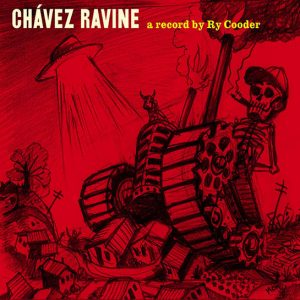
Chavez Ravine: a record by Ry Cooder
Songs. By Ry Cooder. 2005.
The story of the Chicano community bulldozed to pave the way for the Dodger Stadium in Santa Monica, told through bilingual songs.
Order CD online.
Listen to tracks online.
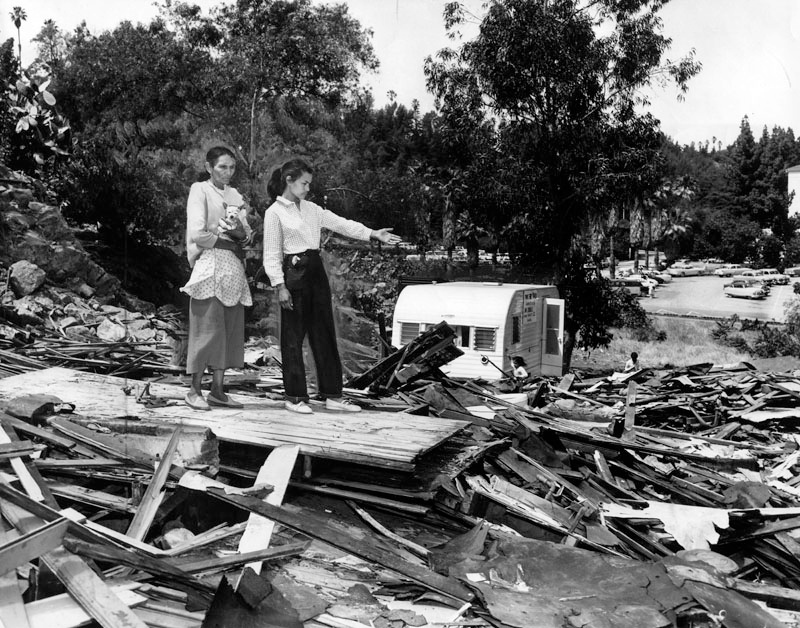
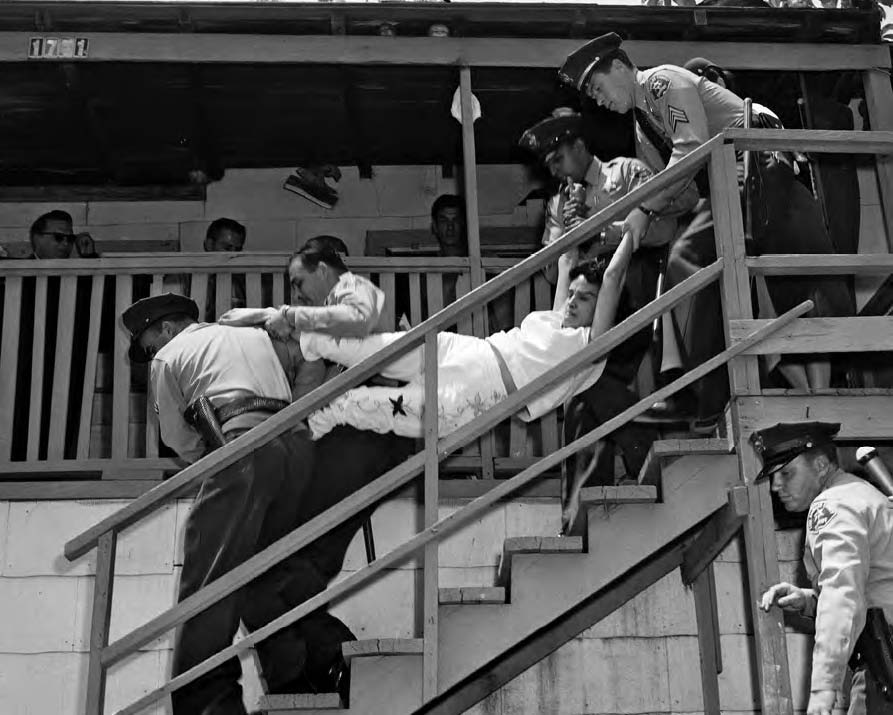
Ry Cooder’s Chávez Ravine-a post World War II-era American narrative of “cool cats,” radios, UFO sightings, J. Edgar Hoover, red scares, and baseball-is a tribute to the long-gone Los Angeles Latino enclave known as Chávez Ravine. Using real and imagined historical characters, Cooder and friends created an album that recollects various aspects of the poor but vibrant hillside Chicano community, which was bulldozed by developers in the 1950s in the interest of “progress”; Dodgers Stadium ultimately was built on the site. Cooder says, “Here is some music for a place you don’t know, up a road you don’t go. Chávez Ravine, where the sidewalk ends.”
Drawing from the various musical strains of Los Angeles, including conjunto, corrido, R&B, Latin pop, and jazz, Cooder and friends conjure the ghosts of Chávez Ravine and Los Angeles at mid-century. On this 15-track album, sung in Spanish and English, Cooder is joined by East L.A. legends like Chicano music patriarch Lalo Guerrero, Pachuco boogie king Don Tosti, Thee Midniters front man Little Willie G., and Ersi Arvizu of The Sisters and El Chicano.
A Los Angeles native, Cooder has been working in Cuba since 1998, producing Buena Vista Social Club, Ibrahim Ferrer, Ferrer’s Buenos Hermanos, and Mambo Sinuendo-all Grammy winners. Three years in the making, Chávez Ravine marks his musical homecoming.
“Los Angeles was paved over, malled up, high-rised, and urban-renewed, as fortunes were made, power was concentrated, and everything got faster and bigger,” comments Cooder. ”But there is a lot I miss now. The texture of certain older neighborhoods, like Bunker Hill, a rural feel in urban places, like Chávez Ravine and the timbre of life there, and just peace and quiet,” he says.
Published by Nonesuch.
Post a comment
Explore by Time Period
- Colonization
- Revolution & Constitution
- Early 19th Century
- Civil War Era
- Reconstruction Period
- Industrial Revolution
- Turn of the Century
- World War I
- Prosperity, Depression, & World War II
- Cold War
- People’s Movement
- 1975 – 2000
- 2001 – Present
- 18th Century
- 19th Century
- 20th Century
- All US History
- 21st Century
Explore by Theme
- African American
- Art & Music
- Asian American
- Civil Rights Movements
- Criminal Justice
- Democracy & Citizenship
- Disability
- Economics
- Education
- Environment & Food
- Immigration
- Imperialism
- Individuals in US History
- Labor
- Language Arts
- Latino
- Laws & Citizen Rights
- LGBT
- Media
- Native American
- Organizing
- Pacific Islander
- Racism & Racial Identity
- Science
- Slavery
- Social Class
- Sports
- US Foreign Policy
- Wars & Related Anti-War Movements
- Women's History
- World History/Global Studies
List of Resources
- Articles
- Audio
- Books: Fiction
- Books: Non-Fiction
- Films
- Picture Books
- Posters
- Profiles
- Songs and Poems
- Spanish/Bilingual
- Teaching Activity PDFs
- Teaching Guides
- Websites
Reading Level
Facebook Status
Zinn Education Project
Saturday, February 4th at 7:12 Today is the birthday of Rosa Louise McCauley Parks (Feb. 4, 1913 – Oct. 24, 2005). Below is a key article by Herbert Kohl from Rethinking Schools that challenges the myths prevalent in children's books and textbooks about Rosa Parks. Here is a link to more resources about Parks and the Montgomery Bus Boycott: http://zinnedproject.org/posts/tag/rosaparks
The Politics of Children’s Literature: What’s Wrong with the Rosa Parks Myth
zinnedproject.org
Aritcle. By Herbert Kohl. 6 pages. A critical analysis that challenges the myths in children’s books about Rosa Parks and the Montgomery Bus Boycott.
Zinn Education Project
Saturday, February 4th at 0:40 via ColorLines Magazine People have taken to Twitter to talk about the histories they wish they'd learned about in high school. Use: #WishiLearnedinHS
Pay Attention! Ethnic Studies #WishiLearnedinHS Curriculum Hits Twitter - COLORLINES
colorlines.com
Educational policies start trending on Twitter.
Zinn Education Project
Friday, February 3rd at 7:25 On this day in 1944, U.S. forces invaded and took control of the Marshall Islands. Who was living there? What is the status of the islands today? The Insular Empire: America in the Marianas is a powerful film on the U.S. colonies in the western Pacific.
Suggestion: ask your students - "Does the U.S. have colonies?" Let us know how they respond.
The Insular Empire: America in the Mariana Islands
zinnedproject.org
The Insular Empire is a one-hour PBS documentary about America’s colonies in the western Pacific. Six thousand miles west of California, the Mariana Islands include the U.S. Territory of Guam and the U.S. Commonwealth of the Northern Mariana Islands (or CNMI). Although most Americans don’t believe t...
You must login to comment.