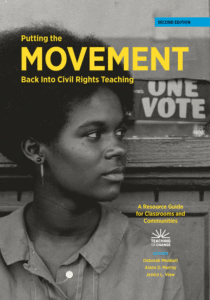
Putting the Movement Back into Civil Rights Teaching
Teaching Guide. Edited by Deborah Menkart, Alana D. Murray, and Jenice L. View. 2004. 576 pages.
Provides lessons and articles for K-12 educators on how to go beyond a heroes approach to the Civil Rights Movement, with a focus on education, economics, labor, youth, women, and culture.
Order book online.
Awarded the 2004 Philip C. Chinn Multicultural Book Award by the National Association for Multicultural Education (NAME).
As one of the most commonly taught stories of people’s struggles for social justice, the Civil Rights Movement has the capacity to help students develop a critical analysis of United States history and strategies for change. However, the empowering potential is often lost in a trivial pursuit of names and dates.
Putting the Movement Back into Civil Rights Teaching, published by Teaching for Change and PRRAC, provides lessons and articles for K-12 educators on how to go beyond a heroes approach to the Civil Rights Movement.
The book includes interactive and interdisciplinary lessons, readings, writings, photographs, graphics, and interviews, with sections on education, labor, citizenship, culture, and reflections on teaching about the Civil Rights Movement.
For more information, visit www.civilrightsteaching.org.
Endorsements
Affiliations at time quote was provided.
“Breathtaking in its array of interdisciplinary lessons, readings, photographs, primary source documents, and interviews, this fertile resource helps students move beyond the “heroes approach” toward a more critical analysis of the civil rights movement.” — Social Studies School Service
“Everyone should learn the story of the Civil Rights Movement. The struggle is depicted here vividly and profoundly by a distinguished roster of authors. Their accounts and analysis should inspire teachers as well as students. This book is as academically rigorous as it is innovative—it is an excellent resource.” — Frank H. Wu, author of Yellow: Race in America Beyond Black and White
“This strong and moving book helps introduce, inform, and illuminate for a new generation the powerful lessons of the civil rights movement for our work today. It will help teachers ‘serve as midwives’ for a more just and caring society.” — Linda Darling-Hammond, Charles E. Ducommun Professor of Education Stanford University
“Civil rights teaching should lift up extraordinary leaders whose personal courage and sacrifice transformed our nation and our history. But it should also recognize the thousands of other acts of resistance and civil disobedience—by neighbors, grandmothers, youth, and everyday heroes—that created an unstoppable tidal wave of ethical conscience and human progress. Putting the Movement Back into Civil Rights Teaching is a unique collection of urgent voices who remind us that true and lasting movements for social, economic, and racial justice begin with you and me.” — Wendy D. Puriefoy, President, Public Education Network
“Putting the Movement Back into Civil Rights Teaching helps teachers and students understand the complexities of the change process in society, making the study of history immediately relevant. In this teaching guide, the Civil Rights Movement claims its rightful place as the inspiration for broader movements for democratic change. This book might just help re-inspire a whole new generation of teachers and students to a life of activism and movement building, not to mention help teachers impart a real understanding of history.” —Mark Simon, Director, MCEA (NEA), Johns Hopkins University Center For Teacher Leadership
“Putting the Movement Back into Civil Rights Teaching gets to the roots of the Movement. It takes the reader beyond the famous leaders, displaying the depth of history, drawing international connections and showing how the pieces of the Movement actually fit together.” — Bill Fletcher Jr., President, TransAfrica Forum
“This is a wonderful resource and will appeal to teachers who want their students to understand that they themselves can play a role in re-making the world.” —Nancy Murray, Director, Bill of Rights Education Project, ACLU of Massachusetts
“This is a much-needed resource for classrooms, and I think it does succeed in putting the Movement back into civil rights teaching!” —Enid Lee, co-editor, Beyond Heroes and Holidays
“It seems to me that the primary strength of this project is its breadth. The book covers a wide range of topics and concerns, including a variety of historical events, several Movement participants, and an array of pedagogical tools and strategies. The combination of lesson plans, historical information, and theoretical analysis makes this a compelling volume. I anticipate that it will be a valuable aid to teachers both in their teaching and in their own understanding of the Movement.” — Stephen Ward, Assistant Professor, Afro-American and African Studies University of Michigan
“Putting the Movement Back into Civil Rights Teaching is one of the only curricula to connect the Civil Rights Movement to the struggles of Native Americans, Latinos, Asian Americans, and women. It’s an incredible tool not just for teaching history, but also for teaching students to take up the legacy these movements helped to create.” —Ariana Quiñones, Deputy Vice President for Education, National Council of La Raza
Published by Teaching for Change and the Poverty and Race Research Action Council (PRRAC).
ISBN: 1878554182
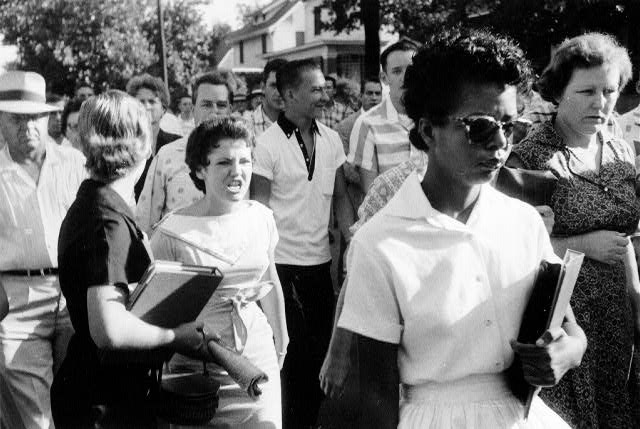
Keywords: SNCC, Montgomery Bus Boycott, Panthers, Melba Patillo Beals, AIM, Aaron Douglas, Memphis Sanitation Workers, Nicolás Guillén, Paul Robeson, Claudette Colvin, Leonard Peltier, Grace Lee Boggs, Sonia Sanchez
Post a comment
Explore by Time Period
- Colonization
- Revolution & Constitution
- Early 19th Century
- Civil War Era
- Reconstruction Period
- Industrial Revolution
- Turn of the Century
- World War I
- Prosperity, Depression, & World War II
- Cold War
- People’s Movement
- 1975 – 2000
- 2001 – Present
- 18th Century
- 19th Century
- 20th Century
- All US History
- 21st Century
Explore by Theme
- African American
- Art & Music
- Asian American
- Civil Rights Movements
- Criminal Justice
- Democracy & Citizenship
- Disability
- Economics
- Education
- Environment & Food
- Immigration
- Imperialism
- Individuals in US History
- Labor
- Language Arts
- Latino
- Laws & Citizen Rights
- LGBT
- Media
- Native American
- Organizing
- Pacific Islander
- Racism & Racial Identity
- Science
- Slavery
- Social Class
- Sports
- US Foreign Policy
- Wars & Related Anti-War Movements
- Women's History
- World History/Global Studies
List of Resources
- Articles
- Audio
- Books: Fiction
- Books: Non-Fiction
- Films
- Picture Books
- Posters
- Profiles
- Songs and Poems
- Spanish/Bilingual
- Teaching Activity PDFs
- Teaching Guides
- Websites
Reading Level
Facebook Status
Zinn Education Project
Saturday, February 4th at 7:12 Today is the birthday of Rosa Louise McCauley Parks (Feb. 4, 1913 – Oct. 24, 2005). Below is a key article by Herbert Kohl from Rethinking Schools that challenges the myths prevalent in children's books and textbooks about Rosa Parks. Here is a link to more resources about Parks and the Montgomery Bus Boycott: http://zinnedproject.org/posts/tag/rosaparks
The Politics of Children’s Literature: What’s Wrong with the Rosa Parks Myth
zinnedproject.org
Aritcle. By Herbert Kohl. 6 pages. A critical analysis that challenges the myths in children’s books about Rosa Parks and the Montgomery Bus Boycott.
Zinn Education Project
Saturday, February 4th at 0:40 via ColorLines Magazine People have taken to Twitter to talk about the histories they wish they'd learned about in high school. Use: #WishiLearnedinHS
Pay Attention! Ethnic Studies #WishiLearnedinHS Curriculum Hits Twitter - COLORLINES
colorlines.com
Educational policies start trending on Twitter.
Zinn Education Project
Friday, February 3rd at 7:25 On this day in 1944, U.S. forces invaded and took control of the Marshall Islands. Who was living there? What is the status of the islands today? The Insular Empire: America in the Marianas is a powerful film on the U.S. colonies in the western Pacific.
Suggestion: ask your students - "Does the U.S. have colonies?" Let us know how they respond.
The Insular Empire: America in the Mariana Islands
zinnedproject.org
The Insular Empire is a one-hour PBS documentary about America’s colonies in the western Pacific. Six thousand miles west of California, the Mariana Islands include the U.S. Territory of Guam and the U.S. Commonwealth of the Northern Mariana Islands (or CNMI). Although most Americans don’t believe t...

You must login to comment.