Rethinking the Teaching of the Vietnam War
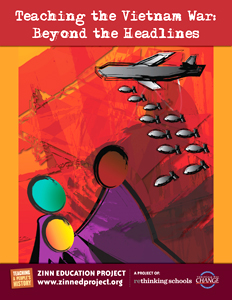
Teaching Activity PDF. By Bill Bigelow. 8 pages.
A role play on the history of the Vietnam War that is left out of traditional textbooks.
Download PDF.
The United Nations has declared this the Decade of Peace. The troubling irony is that teaching for peace must begin with a study of war. Unless we look carefully at the dynamics of war and come to grips with the root causes of global conflicts, we have no way to convincingly propose solutions-no way to imagine peace.
Sadly, when it comes to probing the root causes of the Vietnam War, not a single major U.S. history text glances back beyond the 1950s. Why was the U.S. involved in Vietnam? As James Loewen points out in Lies My Teacher Told Me, his critique of 12 best-selling high school history texts, “Most textbooks simply dodge the issue. Here is a representative analysis, from American Adventures: ‘Later in the 1950s, war broke out in South Vietnam. This time the United States gave aid to the South Vietnamese government.’ ‘War broke out’ — what could be simpler!”
When teachers pattern our curricula after these kinds of nonexplanatory explanations, we mystify the origins not just of the war in Vietnam, but of everything we teach. Students need to learn to distinguish explanations from descriptions, like “war broke out,” or “chaos erupted.”
Thinking about social events as having concrete causes, constantly asking “Why?” and “In whose interests?” need to become critical habits of the mind for us and for our students. It’s only through developing the tools of deep questioning that students can attempt to make sense of today’s global conflicts. However, especially when teaching complicated events like the war in Vietnam, bypassing explanation in favor of description can be seductive. After all, there’s so much stuff about the war in Vietnam: so many films; so many novels, short stories, and poetry; so many veterans who can come in and speak to the class. These are all vital resources, but unless built on a foundation of causes for the war, using these can be more voyeuristic than educational.
Published by Rethinking Schools.
Related resources
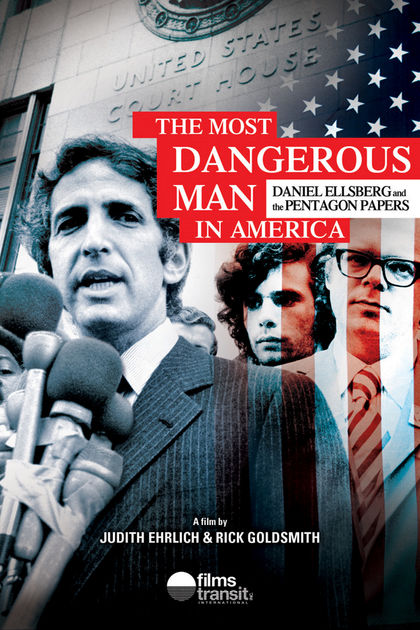
The Most Dangerous Man in America: Daniel Ellsberg and the Pentagon Papers Teaching Guide. This 100-page teaching guide on the Vietnam War and whistleblowing offers an introduction, resource guide, and eight lessons for U.S. history, government, and language arts classrooms. The guide uses a variety of teaching strategies, including role play, critical reading, discussion, mock trial, small group imaginative writing, and personal narrative.
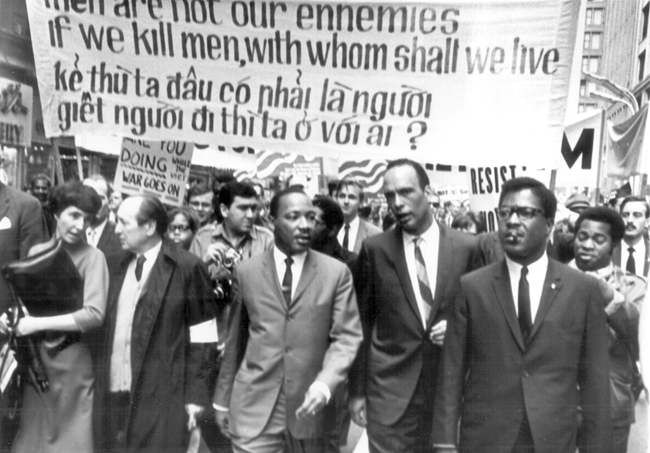
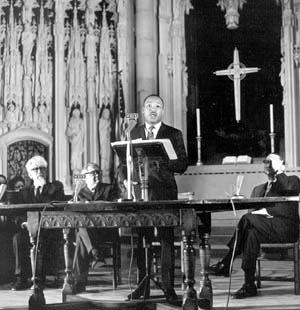
A Revolution of Values. Excerpts from “Beyond Vietnam — A Time to Break Silence,” delivered by Dr. Martin Luther King, Jr. on April 4 1967, at a meeting of Clergy and Laity Concerned at Riverside Church in New York City and teaching ideas. Full text and audio online at AmericanRhetoric.com
Teaching activities, books, and films on the Vietnam War on the Zinn Education Project website.
Keywords: Ho Chi Minh, Viet Minh, France, French, Lyndon Johnson, Dr. Martin Luther King, Jr., Riverside Church, Truman, Hearts and Minds, Hung, Dylan
Post a comment
Explore by Time Period
- Colonization
- Revolution & Constitution
- Early 19th Century
- Civil War Era
- Reconstruction Period
- Industrial Revolution
- Turn of the Century
- World War I
- Prosperity, Depression, & World War II
- Cold War
- People’s Movement
- 1975 – 2000
- 2001 – Present
- 18th Century
- 19th Century
- 20th Century
- All US History
- 21st Century
Explore by Theme
- African American
- Art & Music
- Asian American
- Civil Rights Movements
- Criminal Justice
- Democracy & Citizenship
- Disability
- Economics
- Education
- Environment & Food
- Immigration
- Imperialism
- Individuals in US History
- Labor
- Language Arts
- Latino
- Laws & Citizen Rights
- LGBT
- Media
- Native American
- Organizing
- Pacific Islander
- Racism & Racial Identity
- Science
- Slavery
- Social Class
- Sports
- US Foreign Policy
- Wars & Related Anti-War Movements
- Women's History
- World History/Global Studies
List of Resources
- Articles
- Audio
- Books: Fiction
- Books: Non-Fiction
- Films
- Picture Books
- Posters
- Profiles
- Songs and Poems
- Spanish/Bilingual
- Teaching Activity PDFs
- Teaching Guides
- Websites
Reading Level
Facebook Status
Zinn Education Project
Saturday, February 4th at 7:12 Today is the birthday of Rosa Louise McCauley Parks (Feb. 4, 1913 – Oct. 24, 2005). Below is a key article by Herbert Kohl from Rethinking Schools that challenges the myths prevalent in children's books and textbooks about Rosa Parks. Here is a link to more resources about Parks and the Montgomery Bus Boycott: http://zinnedproject.org/posts/tag/rosaparks
The Politics of Children’s Literature: What’s Wrong with the Rosa Parks Myth
zinnedproject.org
Aritcle. By Herbert Kohl. 6 pages. A critical analysis that challenges the myths in children’s books about Rosa Parks and the Montgomery Bus Boycott.
Zinn Education Project
Saturday, February 4th at 0:40 via ColorLines Magazine People have taken to Twitter to talk about the histories they wish they'd learned about in high school. Use: #WishiLearnedinHS
Pay Attention! Ethnic Studies #WishiLearnedinHS Curriculum Hits Twitter - COLORLINES
colorlines.com
Educational policies start trending on Twitter.
Zinn Education Project
Friday, February 3rd at 7:25 On this day in 1944, U.S. forces invaded and took control of the Marshall Islands. Who was living there? What is the status of the islands today? The Insular Empire: America in the Marianas is a powerful film on the U.S. colonies in the western Pacific.
Suggestion: ask your students - "Does the U.S. have colonies?" Let us know how they respond.
The Insular Empire: America in the Mariana Islands
zinnedproject.org
The Insular Empire is a one-hour PBS documentary about America’s colonies in the western Pacific. Six thousand miles west of California, the Mariana Islands include the U.S. Territory of Guam and the U.S. Commonwealth of the Northern Mariana Islands (or CNMI). Although most Americans don’t believe t...
You must login to comment.